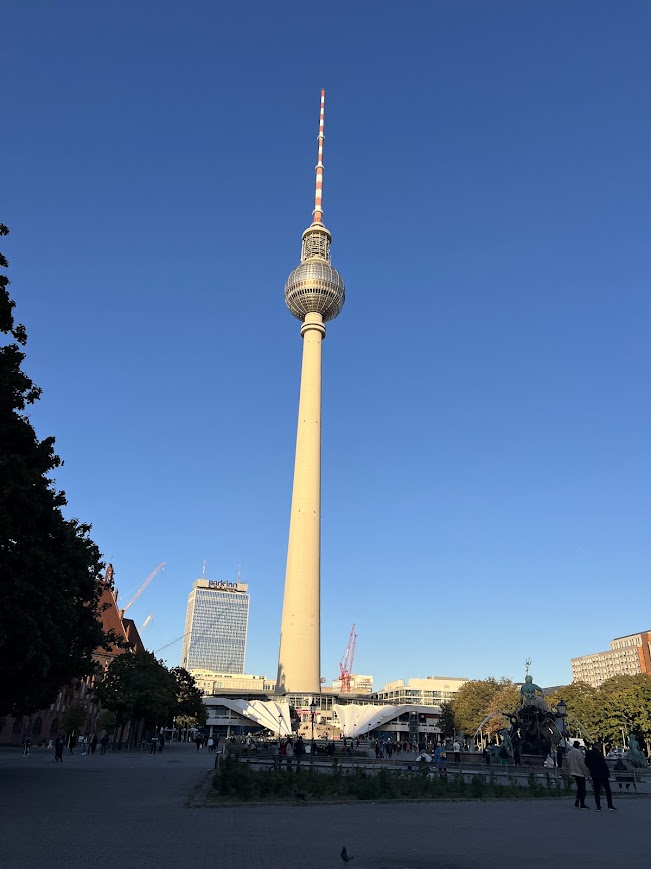
Berlin isn’t for everyone. Do I think that everyone should visit it at least once? Yes. Do I love Berlin each time I visit? No.
However.
It is still one of my favorite places.
Now I may sound like that friend whose relationship status is perpetually summarized by “it’s complicated”, but seriously! Hear me out.
Berlin is a capital city shaped as much by reinvention as by history, with grand architecture and raw creative energy existing side by side. You’ll find world-class museums and quiet residential streets, but also bold street art, a global foodscape, and club scene that I understand to be one of the top three best in the world, if not the best.
For travelers, it’s easy for Berlin to be reduced to a checklist of highlights to be accomplished as quickly as possible. But your time there will be astronomically more impactful if you focus on understanding the layers; past and present, vibrant cultures behind gray concrete.
The Way to Experience It
To do that, approach Berlin with intention, rather than urgency.
There are iconic sites, of course—standing beneath the Brandenburg Gate, walking along remnants of the Berlin Wall, or visiting the museums on Museum Island—but soak in the in-between moments too. Stop in the charming cafe by your hotel, grab a beer from a Späti, and enjoy a döner for dinner on your way home from a club or evening show.
Neighborhoods definitively shape your experience here. Kreuzberg carries a creative, multicultural energy, while Charlottenburg leans more classically residential, with elegant streets and historic buildings. Just taking a walk will introduce you to entirely different versions of the city.
Berlin rewards curiosity. A gallery tucked into a courtyard, a piece of street art that speaks directly to you, a stretch of the Spree River at golden hour—these are the moments that shape a visit.
Food: The Real Highlight
Berlin’s food scene reflects its deeply multicultural, ever-evolving identity. You’ll find traditional dishes like Currywurst and schnitzel, but they’re only one part of the story. Turkish, Middle Eastern, and Eastern European influences are woven into everyday dining, making the city one of Germany’s most diverse culinary destinations.
Markets and casual spots often stand out just as much as fine dining. Street food is taken seriously here, creating mock divisions between locals for which spot has the best döner. Take part in the debate with some of your own research—whether it’s a quick bite between museums or a relaxed evening exploring a local neighborhood.
And while Berlin doesn’t center itself around ritual in the same way some regions do, you’ll still find pockets of tradition—especially when you slow down long enough to look for them.
Art, Architecture & Living History
Berlin is one of the most visually and historically layered cities in Europe.
Grand structures like the Berlin Cathedral and the glass-domed Reichstag Building reflect different eras of power and transparency, while the existing sections of the Wall—noteably in the East Side Gallery—tell more recent stories in bold, visual form.
Berlin openly carries its history. There’s no attempt to smooth over the past. Instead, it’s acknowledged, interpreted, and integrated into the present in ways that are intentional and, at times, striking.
Modern architecture fills in the gaps, creating a cityscape that feels constantly in motion—never frozen in a single identity.
If I Were Planning This Trip
Stay:
- Hotel Adlon Kempinski Berlin — A landmark stay just steps from Brandenburg Gate, combining historic prestige with polished service.
- SO/ Berlin Das Stue — Contemporary, design-forward, and tucked quietly near the Tiergarten (a huge park).
- The Ritz-Carlton Berlin — It’s hard to argue with a classic! This one is great logistically as well, right next to the hub that is Potsdamer Platz, on the edge of the Tiergarten and down the street from Brandenburg Gate.
Do:
- Visit Museum Island, but focus on one or two museums rather than trying to see everything. And don’t miss the Jewish Museum. If you have to skip Museum Island to fit it in, skip it.
- Walk or bike along the Spree River to experience the city at a slower pace.
- Wander neighborhoods like Kreuzberg or Prenzlauer Berg without a fixed agenda; taking in the street art and stopping for snacks and drinks wherever they look good.
- Take time for a guided historical tour to better understand the city’s context.
Timing:
Late spring and early autumn are ideal—good weather, fewer crowds, and the city alive to enjoy alongside you. December offers a completely different atmosphere with Christmas markets sprinkled across the city.
Who This Place Is (and Isn’t) For
Berlin is ideal for travelers who value depth over polish—those who appreciate history, culture, and a sense of place that isn’t intended just for show. If you’re looking for a gritty (in the best way), perspective-shaping city, this is the place.
If you’re looking for a picture-perfect, uniformly beautiful European city with a slower, romantic rhythm, Berlin will be too rough around the edges. It is a product of its past, as much as any of the rest of us are. As such, it’s not for everyone.
In Conclusion
Berlin stands apart because it doesn’t try to paint over its complexity.
It’s a city where history is visible, creativity is constant, and no single narrative defines the experience. What you take away from it will depend on what you choose to notice—and how much space you give yourself to explore beyond the obvious.
Berlin isn’t the easiest place. But I can promise that it will stay with you.

Let’s work on your personalized Germany itinerary!
Find me on Travel Leaders Network!


