Eastern Germany can be perceived as catching up to the rest of the country, due to the years these states spent behind the Iron Curtain. Shaped by forests, rivers, reform movements, and artistic legacy, however, this region is a place of ideas — where philosophy, music, craftsmanship, and political change took root. Though often quieter than Germany’s western and southern states, its cultural significance is worth examining.
This article explores four states that form Germany’s intellectual heartland: Saxony, Thuringia, Saxony-Anhalt, and Brandenburg. Bound together by geography and history, these states reveal a Germany that is reflective and creative.
Saxony (Sachsen)
Think: Baroque grandeur, music, and creative resurgence
Saxony has long been one of Germany’s great cultural powerhouses. Anchored by the Elbe River, its cities flourished through trade, royal patronage, and artistic ambition. Dresden became synonymous with Baroque splendor, while Leipzig emerged as a center of music, publishing, and intellectual life.
The region’s geography — river valleys bordered by rolling hills and sandstone formations — protected both prosperity and artistic inspiration. Following the devastation wrought in the 20th century, Saxony was rebuilt with remarkable care, preserving its architectural legacy while structuring itself for contemporary needs.
Saxony is elegant yet alive: grand museums, walkable historic centers, and a thriving arts scene that feels grounded rather than curated.
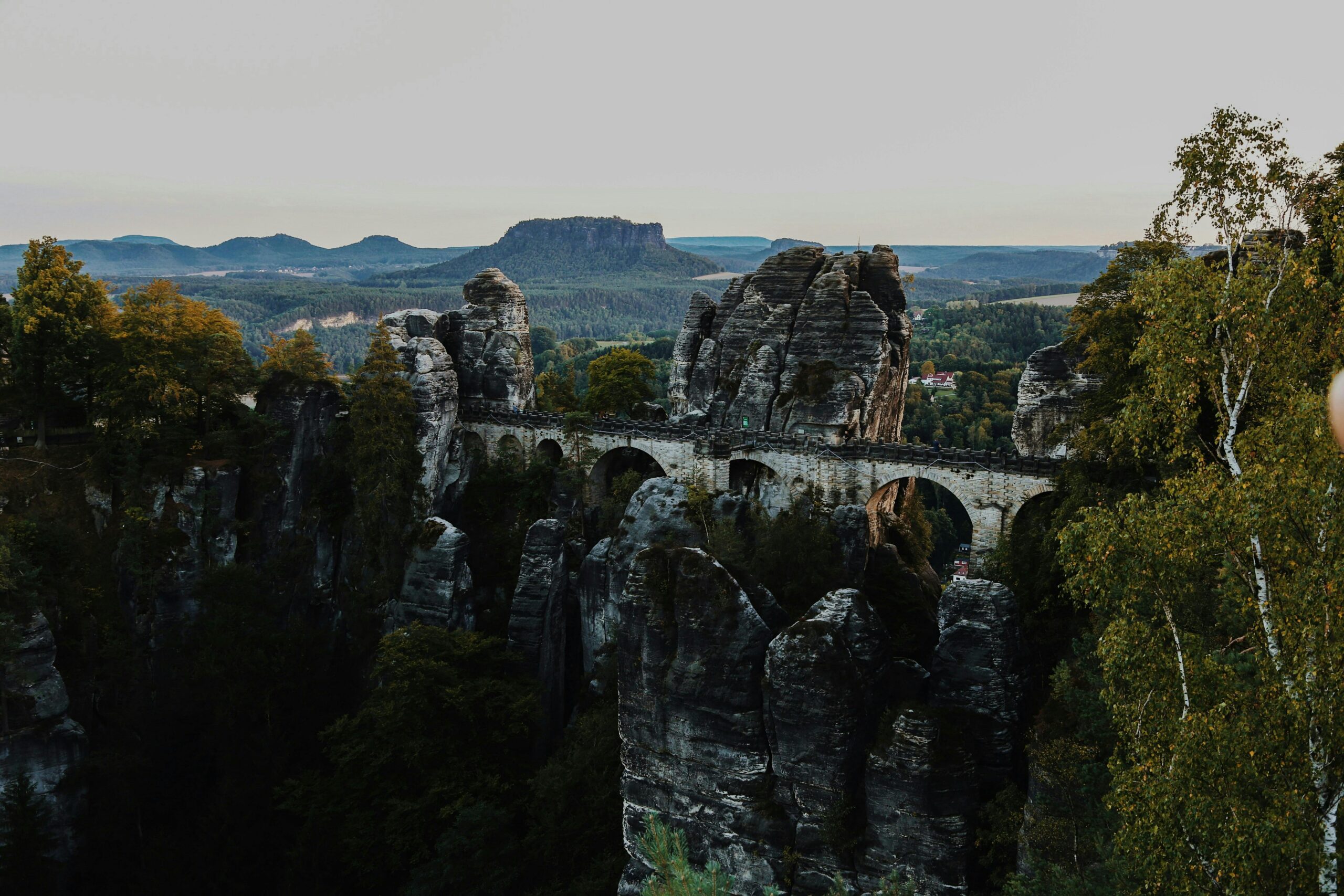
Destination Highlight: Bastei Bridge, a structure spanning rock formations in the Elbe Sandstone Mountains that looks like it belongs in Middle Earth.
Thuringia (Thüringen)
Think: Forests, philosophy, and the reformation spirit
Known as the “Green Heart of Germany”, Thuringia is defined by forested hills, quiet valleys, and towns that feel suspended in time. Its geo-political history encouraged smaller communities with strong identities, and has served as the shelter of thinkers, composers, and reformers.
Goethe, Schiller, Bach, and the Bauhaus movement all left indelible marks here. With a contemplative, wooded landscape, you can see why introspection, artistry, and intellectual life have long been highly valued here.
For travelers, Thuringia feels deeply authentic. It’s not about spectacle, but substance: beautifully preserved towns, meaningful museums, and plenty of open space to wander reflectively.
Destination Highlight: Wartburg Castle, the thousand-year-old fortress where Martin Luther translated the New Testament into German.
Saxony-Anhalt (Sachsen-Anhalt)
Think: Architectural icons and medieval heritage
Saxony-Anhalt occupies a pivotal place in German and European history. Its plains and river corridors supported early settlements, while the Harz mountains added character to the landscape and fodder to folktales. Its towns served as centers of religious and political change.
Saxony-Anhalt is the birthplace of the Protestant Reformation, where Martin Luther’s ideas reshaped Europe before he fled to nearby Thuringia. Romanesque churches, medieval fortifications, and early Renaissance architecture remain remarkably intact in this quiet locale. You can plan entire itineraries just around those Romanesque structures!
You’ll find Saxony-Anhalt compelling — rich in UNESCO sites, quiet beauty, and archaeological relevance without the crowds.
Destination Highlight: Harz National Park, established in 2006, a mountainous region that can be explored on foot or with mountain bikes along inspired routes such as the Harz Witches’ Trail.
Brandenburg
Think: Lakes, monarchs, and Prussian history
Encircling Berlin, Brandenburg is a land of forests, lakes, and extensive navigable waterways — a geography that shaped Prussia’s rise and provided respite from urban life. Its open landscapes are dotted with hunting lodges, palaces, and carefully designed parks, many of which remain today.
Brandenburg feels spacious and diverse. Villages are spread out, structures of past royalty continue to inspire, and local delicacies keep the particularly German temperament alive and well. You may be surprised by the region’s accessibility from Berlin – tranquility that’s just beyond the city’s borders.
For visitors and locals, Brandenburg offers breathing room — scenic drives, laidback canal floats, and UNESCO landmarks spread serenely across the region.
Destination Highlight: Spreewald Forest, a protected natural biosphere reserve that you should explore via a traditional barge.
Bringing These States Together
Saxony, Thuringia, Saxony-Anhalt, and Brandenburg share a cultural lineage shaped by ideas, artistry, and geography rather than commerce or industry. Forests encouraged contemplation, rivers carried music and philosophy, and towns became centers of learning and reform.
Together, they unveil a Germany that is:
- Thoughtful and creative
- Influential beyond its borders
- Quietly beautiful and tied to water formations
As is true of much of Germany, this region rewards curiosity and patience — offering experiences that encourage lingering in your destination.
What’s Next in the Germany Series
In the next article, we’ll turn north to focus on Germany’s coastal and maritime states, where sea air, open horizons, and design-forward cities offer a very different rhythm of travel. Plus, the city-state of the capital, Berlin.
To stay connected as the series continues, be sure to sign up for my email list — each article builds on the last, nurturing a deeper understanding of Germany.
Missed last week’s article on the western states? You can check it out here!

Let’s work on your personalized Germany itinerary!
Find me on Travel Leaders Network!


